Research Proposal Template
Write a clear, well-organised research proposal. The pack includes full Word templates for a thesis or dissertation proposal, a short student research proposal and a grant-style proposal, plus an Excel timeline and budget and a literature matrix to organise your reading.
Research Proposal Template Pack
Thesis, short student and grant-style proposal templates, timeline and budget workbooks, a literature review matrix and a submission checklist.
- Thesis / dissertation proposal (PDF, DOCX)
- Short student proposal (PDF, DOCX)
- Grant-style proposal (PDF, DOCX)
- Timeline workbook (Excel)
- Budget workbook (Excel)
- Literature matrix (Excel)
- Submission checklist (PDF, DOCX)
Formats: PDF, DOCX, XLSX. Instant download after payment (link valid 72 hours, up to 5 downloads). AI-assisted: the templates were drafted with AI help and reviewed and laid out by Kedop.
$12.00 USD, one-time
Secure card checkout by Stripe. Full refund within 7 days — see the refund policy and license.
What a research proposal must do
A research proposal persuades a supervisor, committee or funder that your question is worth asking, that you know the existing research, and that your plan can realistically answer the question with the time and resources you have. Whatever the discipline, readers look for the same things: a focused question, a justified gap, a method that fits the question, awareness of limitations and ethics, and a feasible timeline. The templates are organised around those expectations.
What is included
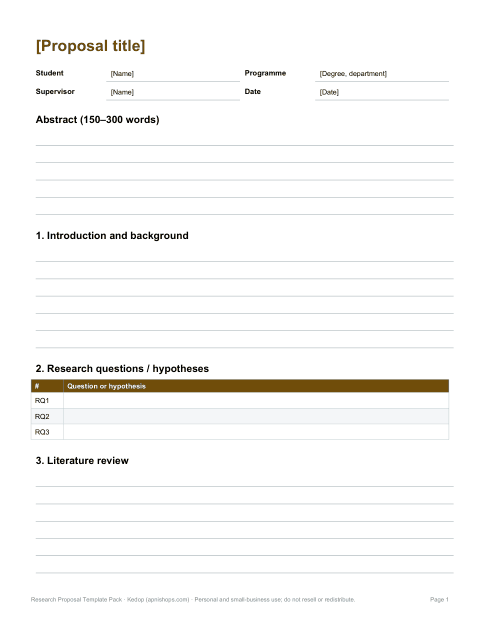
- Thesis / dissertation proposal (Word) — title page, abstract, introduction, research questions, literature review, methodology, ethics, timeline, references and appendices.
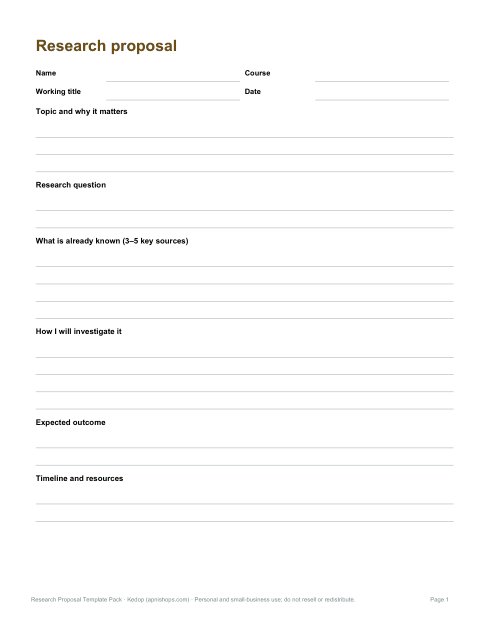
- Short student research proposal (Word) — a 2–4 page version for undergraduate projects, capstones and course assignments.
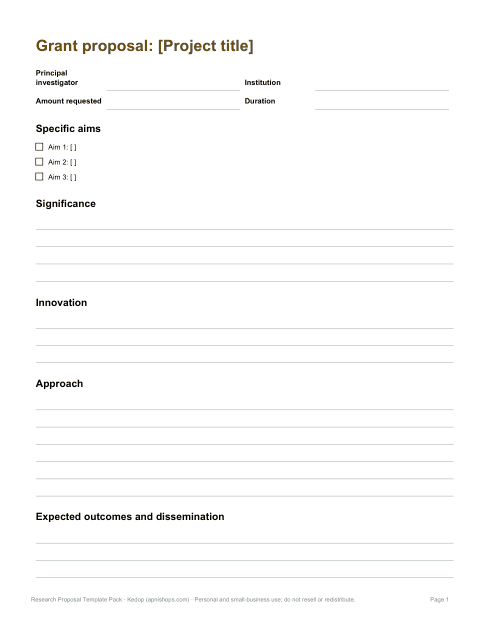
- Grant-style proposal (Word) — specific aims, significance, innovation, approach, expected outcomes, budget justification and dissemination.
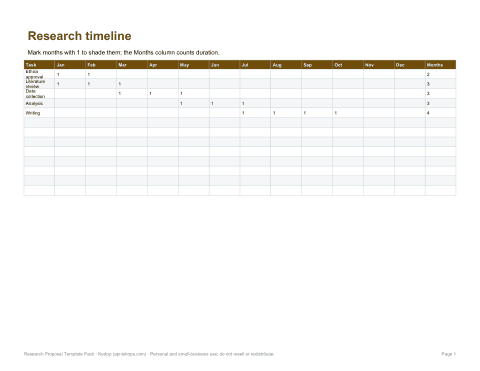
- Research timeline workbook (Excel) — tasks by month with a Gantt-style grid.
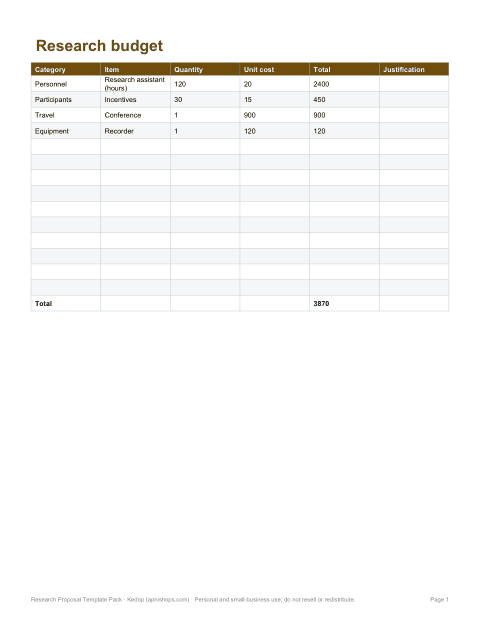
- Research budget workbook (Excel) — personnel, equipment, travel and participant costs with totals.
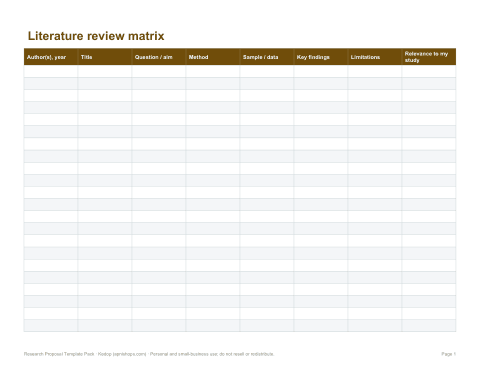
- Literature review matrix (Excel) — organise sources by author, method, findings and relevance.
- Proposal checklist — a final self-review before submission.
The standard proposal structure
| Section | What to include | Typical length (thesis proposal) |
|---|---|---|
| Title and abstract | Specific title; 150–300 word summary | ½ page |
| Introduction and background | Context, problem, why it matters | 1–2 pages |
| Research questions / aims | One main question, 2–4 sub-questions or hypotheses | ½ page |
| Literature review | Key studies, debates and the gap your work fills | 3–8 pages |
| Methodology | Design, data, participants or materials, analysis, validity | 3–6 pages |
| Ethics and limitations | Consent, data protection, risks, constraints | ½–1 page |
| Timeline and resources | Milestones and what you need | ½–1 page |
| References | In your required citation style | As needed |
Always check your department or funder's own guidelines: many specify headings, word limits and formatting that override general templates.
Writing a strong research question
- Make it specific: name the population, variables or texts and the setting.
- Make it researchable with the data and methods you can realistically access.
- Avoid yes/no questions unless testing a hypothesis; ask “how”, “to what extent” or “what factors”.
- Check that answering it would add something the literature does not already say.
- Keep the scope achievable in the time available — a narrower question answered well beats a broad one answered vaguely.
Using the timeline and budget workbooks
The timeline workbook lists tasks — ethics approval, literature review, data collection, analysis, writing, revisions — against months, and shades the months each task runs, producing a simple Gantt chart you can paste into the proposal. The budget workbook groups costs into categories with quantities and unit costs and totals them, with a column for justification text that many funders require. Both use ordinary formulas, so they work in Excel, Google Sheets and LibreOffice.
Who it is for
Undergraduate and master's students writing a project or thesis proposal, doctoral candidates preparing for a proposal defence, early-career researchers drafting internal or small grant applications, and professionals proposing research within their organisations. The templates are discipline-neutral, with prompts that work for qualitative, quantitative and mixed-methods research.
Formats
Proposals and the checklist are editable DOCX files with PDF previews; the timeline, budget and literature matrix are XLSX workbooks. Heading styles are built in so you can generate a table of contents automatically in Word.
Common reasons proposals are sent back
Supervisors and reviewers often return proposals for the same reasons: the question is too broad for the time available; the literature review summarises sources one by one instead of showing the gap; the methods do not match the question (for example, a survey proposed to explain processes better studied through interviews); ethical risks are not addressed; or the timeline leaves too little time for analysis and writing. The checklist in the pack targets each of these so you can fix them before submission.
Frequently asked questions
How long is a research proposal?
Student proposals are often 2–4 pages; thesis and dissertation proposals often 10–25 pages; grant proposals follow the funder's page limits.
Does the pack cover a specific citation style?
Use your required style (APA, MLA, Chicago, Harvard). The templates include a references section and placeholders you can format in any style.
Can I use the grant template for a real funding application?
It is a strong starting structure, but funders usually require specific forms and headings; always follow their call exactly.
Is it suitable for qualitative research?
Yes. The methodology prompts cover qualitative, quantitative and mixed-methods designs.
Was AI used to create the templates?
The templates were drafted with AI assistance, then reviewed, edited and formatted by Kedop. They contain structure and prompts, not ready-made research content.